


BEST DARN
NEWSLETTER, PERIOD!
Practical Insights for Real-Time Automation
3rd Quarter 2026 • Issue 81

Inside This Issue
John’s corner
Extreme Courage In The Midst Of Ultimate Horror
A column of personal opinion by John S. Rinaldi, founder and owner of Real Time Automation
There are countless heartbreaking stories of terror, cruelty and mass death associated with World War II Europe. I’ve told a few here and learned a few more on my recent tour of Polish World War II historical sites.
No matter what I read, what I see and what stories I’m told, I continue to be mystified by the savagery, inhumanity and callousness exhibited, not only on the battlefield, but behind the lines in Eastern Europe. It’s impossible to understand cruelty on that extreme scale. It truly is unimaginable.
Even more perplexing is how some people found the courage to fight that barbarism. I was very lucky on this trip to learn the story of Irena Sendler and visit her memorial. While camp guards were stomping out Jewish lives at extermination camps around Poland, Irena, less than 50 miles away, was rescuing every Jewish child she could lay her hands on.
In 1939, Warsaw and the rest of Poland fell quickly to the Germans from the West and the Soviets from the East. The Germans immediately began their plan of Nazification by turning much of the city center to rubble and confining over 460,000 Warsaw Jews to a cramped, 1.3 square mile Ghetto with limited access to food and water. Some were deported to extermination camps. Others were killed in the uprising of 1943. A mere 20,000 escaped. Parts of that Ghetto wall still stand today. It’s eerie to stand before that tall 20ft wall, imagine it ringing the Ghetto, contemplating the human suffering it represents.
Irena, with her Warsaw social services job, was one of the very few who had permission to enter and exit the Ghetto at will. She used that permission to smuggle out Jewish children; some estimates are as high as 2,500. She would tell a mother, “I can’t save you, but I can save your child.” To sneak babies and young children past the guards, she would often chloroform them. Once outside the ghetto, she forged documents, gave them Christian names and taught them Christian songs to avoid detection. She placed them in convents or with families all over the countryside. Hoping for reunification after the war, she buried jars with both the original and new children’s names under her apple tree.
In May of 1943, the Nazi SS brutally exterminated the remaining 50,000 Jews in the Ghetto. Even though the penalty for assisting Jews was death – not only your own but that of your entire family – Irena assisted many who escaped the slaughter, but her luck ran out in October of that year. She was arrested by the Gestapo, taken to the brutal Pawiak prison and nearly beaten to death. Even under relentless suffering and incessant interrogations, she steadfastly refused to betray her comrades or the children she rescued. She narrowly escaped execution only because the Jewish underground bribed a prison guard.
After the war, she continued her efforts, establishing the Warsaw’s Children’s Home under the Communist regime. For her wartime efforts, she received numerous awards, including the Gold Cross of Merit. In 1965, she was recognized by Yad Vashem as one of the Righteous Among the Nations. That award is the highest given by the state of Israel and it is reserved for those exemplary individuals who risked their lives to save Jews during the Holocaust.
Irena Sendler’s achievements were largely unknown in North America until 1999, when students at a high school in Kansas produced a play based on their research into her life story, titled Life in a Jar.
You have to wonder what drives someone to risk life and limb for strangers. Irena wasn’t a Jew. She was a Catholic. She had a comfortable government job. Probably had access to water, food and a comfortable apartment. Yet she risked her life for strangers.
Her words shed some light on this:
“Every child saved with my help is the justification of my existence on this Earth, and not a title to glory.” — Irena Sendler

John S. Rinaldi
President
| Manufacturing plants I see are typically | |
|---|---|
| Highly segmented | 7% |
| Moderately segmented | 45% |
| Partially segmented | 41% |
| Not segmented – flat networks | 7% |
| Network Address Translation (NAT) | |
|---|---|
| Love it, use it extensively | 9% |
| Have used it occasionally | 60% |
| Never use it | 20% |
| Not sure what NAT is | 11% |
| Data Modeling | |
|---|---|
| Can’t tell you what a data model is | 16% |
| Not my job | 51% |
| We have some data models | 32% |
| We have master data models | 1% |
| ERP – MES – SCADA | |
|---|---|
| Still has extensive manual components | 14% |
| Is sourced from a single vendor | 25% |
| Is sourced from multiple vendors | 61% |
| Is UNS-based | 0% |
| User Defined Data Types (UDT) | |
|---|---|
| Exist only in the PLC | 55% |
| Are documented outside the PLC | 16% |
| Exist as a data model in an IT system | 8% |
| Don’t use them | 21% |
| Manufacturing plants I see use paper records | |
|---|---|
| Never | 7% |
| In a few places | 70% |
| Quite a bit | 23% |
Unlock the Power of Modbus Devices and AI
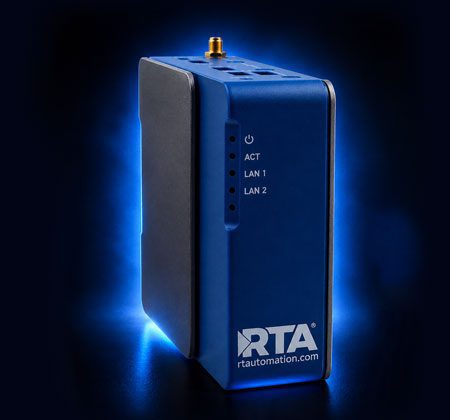
The latest update to the RTA Historian expands your automation data collection to edge devices and empower your team with AI-assisted data analysis.
- Modbus Device Support (ASCII, RTU and TCP)
- Direct, secure connection with popular AI platforms
- Expanded access to diagnostic metrics to triggers and functions
- Streamlined configuration of new data sources and models
- Improved UX in key functional areas
Technical Deep Dive
How Well Do You Know Your Industrial Switches?
By John S. Rinaldi
What many people don’t understand is that a production system is a seamlessly integrated production application and Ethernet network, and that is fundamentally different from an IT environment.
In IT, the network is independent of what’s running on your desktop or server. If one or two machines disconnect, the network keeps serving its purpose. In a production system, the network is useless without the production application, and the application is useless without the network. They are one system.
At the center of that system sits the industrial switch. Yet for many in automation, the basics of how these switches operate remain a mystery. Below we break down the 15 questions every automation professional should be able to answer, along with the one challenge that even experienced engineers often overlook.
1. What does the MAC table in a switch actually do?
It manages the list of devices (MAC addresses) connected to each port. Switches build this table by examining the source of Ethernet frames. When a device doesn’t know a destination MAC address, it issues an Address Resolution Protocol (ARP) broadcast to find it. The responding device is then added to the table.
2. What is the one main advantage of an unmanaged switch?
Cost. Unmanaged switches are simple, inexpensive and require zero configuration, which also makes them appropriate only for the simplest network segments.
3. What do managed switches offer that unmanaged switches don’t?
Managed switches support Secure Shell (SSH), Simple Network Management Protocol (SNMP), Virtual Local Area Networks (VLANs), port mirroring, Quality of Service (QoS), redundancy protocols, Internet Group Management Protocol (IGMP) snooping and a range of additional functionality that is essential for any production network with real monitoring or security requirements.
4. What is the result of not configuring a managed switch with a gateway address?
Without a gateway address, the switch cannot respond to messages from devices outside its local network. If the local network is 192.168.100.x and a request originates from 192.168.101.1, the switch has no route for the response and it is simply discarded.
5. What is a Virtual Local Area Network (VLAN)?
A Virtual LAN creates a private broadcast domain, essentially a virtual network for a specific segment of the production system. Only messages that are “tagged” with the VLAN identity can access that network.
6. What are the reasons to use a VLAN?
Three reasons: VLANs create boundaries between groups of devices; VLANs provide security by limiting broadcast traffic to authorized segments; and segmenting a section of a line or machine using a VLAN can increase performance.
7. When would you use port mirroring?
For troubleshooting. When port mirroring is enabled on a managed switch, traffic from one port is copied and transmitted on the mirror port, giving you visibility into live traffic without interrupting it.
8. Why would you use a private Simple Network Management Protocol (SNMP) community string?
The SNMP community string is essentially a password for SNMPv1 and v2c. While the generic community (“public”) string is widely used, a user can define a private SNMP community string to enhance security. Clients must know the community string to access the switch using SNMP. The community string is not used in SNMP v3.
9. What is the purpose of Secure Shell (SSH)?
SSH (Secure Shell) provides secure access to the management interface of a switch via the CLI. It’s commonly used to report switch configuration and operating status, and is far preferable to Telnet, which transmits credentials in plain text.
10. What is the difference between a Layer 2 Switch and a Layer 3 switch?
Most switches operate at Layer 2, moving messages between MAC addresses on the same local link. Layer 3 switches add limited IP routing capability, allowing messages to be forwarded to a second local network without a dedicated router.
11. How might a duplex mismatch affect your control system?
A duplex mismatch occurs when a switch port and a connected device fail to negotiate full-duplex mode, where one ends up listening while the other is transmitting. On links that carry heavy data traffic, this creates collisions and latency that can degrade control system performance.
12. What is one way to extend port capacity when you run out of ports on a switch?
You can cascade switches (connecting one switch to another), use switch stacking or create uplinks. Keep in mind that cascading increases the number of devices in the broadcast domain, which can affect performance if not managed carefully.
13. Why would you want to monitor switch status in real time?
Using a switch monitoring tool or the management interface of a switch, you can identify links that have CRC errors, duplex errors and devices with links that may be failing.
14. Why is the packet forwarding rate important?
In principle, it reflects how many million packets per second a switch can forward. In practice, for typical industrial control systems using EtherNet/IP, PROFINET or Modbus, it’s rarely the bottleneck. Almost every switch on the market exceeds what these protocols require.
15. What happens when a device initially connects to a switch?
The switch port and device go through an autonegotiation process to determine baud rate and duplex settings. After that, nothing happens unless the device sends a message or the switch forwards an ARP broadcast looking for a destination address.
There are differences between industrial switches. The differences include ruggedization, temperature, vibration tolerance, MTBF, redundancy protocols and integration with industrial tools. The browser interface varies from one switch to the next.
Reliability is pretty good on almost every switch. People tend to prefer one brand over another, just like automobiles. That same thing happens with industrial switches. Many companies standardize on one brand and stick with it forever.
The biggest issue with industrial switches is their status reporting capabilities. Switches support SSH, SNMP and SNMP traps (alarms). These mechanisms don’t always integrate well into the tools that control engineers use to monitor and maintain control systems.
One of the most interesting features of an industrial switch is the ability to support some IP routing. Switches with that capability are called Layer 2+, Layer 2 Plus, Layer 2/3 and more.
In the diagram below, two Layer 2+ switches each manage a local link (10.5.3.x and 10.5.4.x) while also supporting I/O devices on a 192.168.1.x network. Messages from the PLC can be routed to I/O devices, other local devices and out through the IT router, all without a dedicated Layer 3 router at every junction.
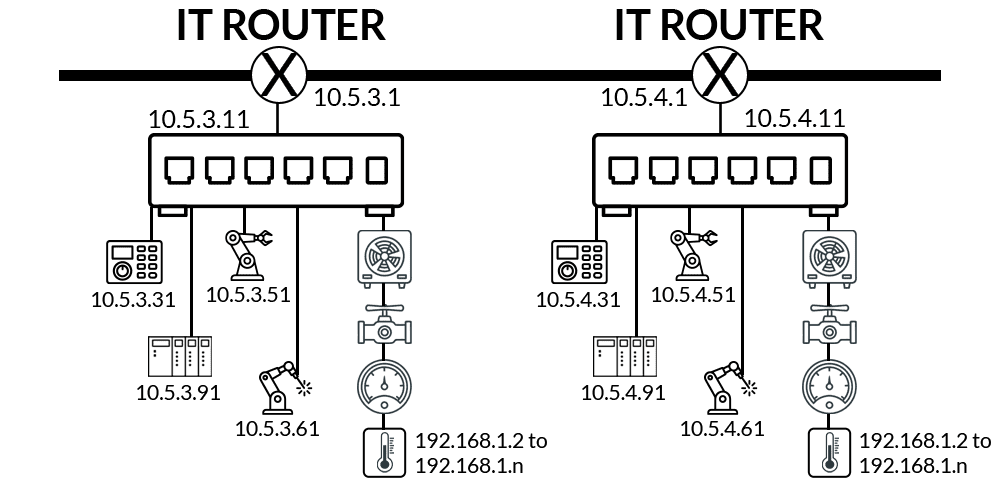
This architecture is common in modern industrial networks, but the routing behavior adds another layer of status and configuration that must be visible to the automation team, not just the IT department.
If you or your team would like more detailed information about Ethernet switches, contact us.
A new voice at RTA
Meet Roy Kok, The New VP Of Sales And Marketing
By Roy Kok
My name is Roy Kok, and John says I can’t hold a job…I beg to differ. Wonderful opportunities keep coming my way, and I am very proud to say I am now heading up an incredible team of sales and marketing professionals at Real Time Automation.
John said to tell you about me. We run a personal business – our customers are more than that. They’re our friends.
Truth be told, I could consider retiring, but I don’t often act my age. I still have a lot of game left in me and too much love for this industry. My 40-year career began at Kaye Instruments, where I spent 13 years, earned an electrical engineering degree from Northeastern University and pivoted from engineering to programming and global applications. From there, my career became a dynamic back-and-forth between sales and marketing. I joined Intec Controls (later acquired by Nematron), managed marketing at Imagination Systems and served as VP of Marketing at VenturCom until the .COM bubble burst.
Thanks to good friends, I bounced back at SyTech, which led to a Product Marketing role at Intellution (acquired by GEFanuc), where I managed major product lines like iFIX and CIMPLICITY. Kepware then approached me to head their sales and marketing, driving major growth until the 2010 global recession hit. Ever adaptive, I transitioned to market research as the marketing head for ARC Advisory Group, before being recruited to lead sales and marketing for Dream Report. When COVID-19 disrupted that role, I pivoted to managing marketing for CESMII, focusing on smart manufacturing data modeling. Most recently, my long-time friend Thomas Burke recruited me to Mitsubishi Electric, where I ran their e-F@ctory Alliance and CC-Link Partner programs.
I could have ridden off into the sunset from there, but my two kids are grown and successfully launched, and my wonderful wife of 37 years doesn’t mind me getting out of the house—which also leaves plenty of time for pickleball! I’m eager to make one more big difference by applying my decades of expertise.
Thank you to John Rinaldi for this exciting Real Time Automation opportunity! I can’t begin to tell you about all our opportunity for growth today – but I will in future newsletters.
What do I do for fun? When not working, I’m often enjoying my grandson, or tinkering with some technology, or teaching my grandson how to tinker with some technology (I get to buy so many toys now, using him as an excuse).
I bought a trawler 15 years ago. She was built in 1987, steel hull and lots of work. But that’s my big toy and my hobby. If I had to pay for all the work, I couldn’t afford it. So I’m really good at scraping and repairing rust. The ship’s bridge has a Windows computer with open-source charting software. I’ve added Modbus compatible I/O modules for monitoring all key temperatures and voltages with a SCADA package. If you want to know more, here’s an article I wrote a long while back. https://passagemaker.com/technical/pc-on-board-now-what/
Enough about me. I love the new features of the RTA Historian. We just released it with additional Modbus connectivity in addition to the Rockwell Automation PLC connectivity. There’s new MCP (Model Context Protocol) connectivity so AI can make use of the stored data. We have many more enhancements on the way. This is a little h historian, for embedding in a machine or use in small applications. With up to a terabyte of memory, it’s quite the workhorse. It doesn’t replace the need for an enterprise Historian (H), it becomes a front-end to it. Think of our historian as the black box flight data recorder with high fidelity data for equipment troubleshooting. This is an awesome addition to our Gateway and Stack business.
I look forward to getting to know all our customers and I’d love to hear from you. Email me at rkok@rtautomation.com or connect with me on LinkedIn, linkedin.com/in/roykok.

Roy Kok
VP of Sales & Marketing

Complete our quick survey by August 15, 2026 and we’ll launch a custom Dart Rocket your way!
Perfect for the office, backyard or settling highly scientific debates about whose throw goes the farthest. Just fill out the survey and we’ll send one flying your way.
Take the survey by 8/15/26 at rtautomation.com/steal.

View Our Past Newsletters
- Issue #81 - Quarter 3 2026
- Issue #80 - Quarter 2 2026
- Issue #79 - Quarter 1 2026
- Issue #78 - Quarter 3 2025
- Issue #77 - Quarter 2 2025
- Issue #76 - Quarter 1 2025
- Issue #75 - Quarter 4 2024
- Issue #74 - Quarter 3 2024
- Issue #73 - Quarter 2 2024
- Issue #72 - Quarter 1 2024
- Issue #71 - Quarter 4 2023
- Issue #70 - Quarter 3 2023
- Issue #69 - Quarter 2 2023
- Issue #68 - Quarter 1 2023
- Issue #67 - Quarter 4 2022
- Issue #66 - Quarter 3 2022
- Issue 65 - Quarter 2 2022
- Issue 64 - Quarter 1 2022
- Issue 63 - November 2021
- Issue 62 - September 2021
- Issue 61 - July 2021
- Issue 60 - May 2021
- Issue 59 - March 2021
- Issue 58 - January 2021
- Issue 57 - November 2020
- Issue 56 - September 2020
- Issue 55 - July 2020
- Issue 54 - May 2020
- Issue 53 - March 2020
- Issue 52 - January 2020
- Issue 51 - November 2019
- Issue 50 - September 2019
- Issue 49 - July 2019
- Issue 48 - May 2019
- Issue 47 - March 2019
- Issue 46 - January 2019
- Issue 45 - November 2018
- Issue 44 - September 2018
- Issue 43 - July 2018
- Issue 42 - May 2018
- Issue 41 - March 2018
- Issue 40 - January 2018
- Issue 39 - November 2017
- Issue 38 - September 2017
- Issue 37 - July 2017
- Issue 36 - May 2017
- Issue 35 - March 2017
- Issue 34 - January 2017
- Issue 33 - November 2016
- Issue 32 - September 2016
- Issue 31 - July 2016
- Issue 30 - May 2016
- Issue 29 - March 2016
- Issue 28 - January 2016
- Issue 27 - November 2015
- Issue 26 - September 2015
- Issue 25 - July 2015
- Issue 24 - May 2015
- Issue 23 - March 2015
- Issue 22 - January 2015
- Issue 21 - November 2014
- Issue 20 - September 2014
- Issue 19 - July 2014
- Issue 18 - May 2014
- Issue 17 - March 2014
- Issue 16 - January 2014
- Issue 15 - November 2013
- Issue 14 - September 2013
- Issue 13 - July 2013
- Issue 12 - May 2013
- Issue 11 - March 2013
- Issue 10 - January 2013
- Issue 9 - November 2012
- Issue 8 - September 2012
- Issue 7 - July 2012
- Issue 6 - May 2012
- Issue 5 - March 2012
- Issue 4 - January 2012
- Issue 3 - November 2011
- Issue 2 - September 2011
- Issue 1 - July 2011