

RTA's Blog
Industrial Control Comes to the Data Center
Jun
There is revolutionary change in how we build data centers. Compared to what we are starting to build today, current data centers are like the Slave Rock and Gravel Company from the Flintstones.
The next 50 gigawatts of data center capacity will be built more like chemical plants. I’m not at all sure that the data center industry has figured that out.
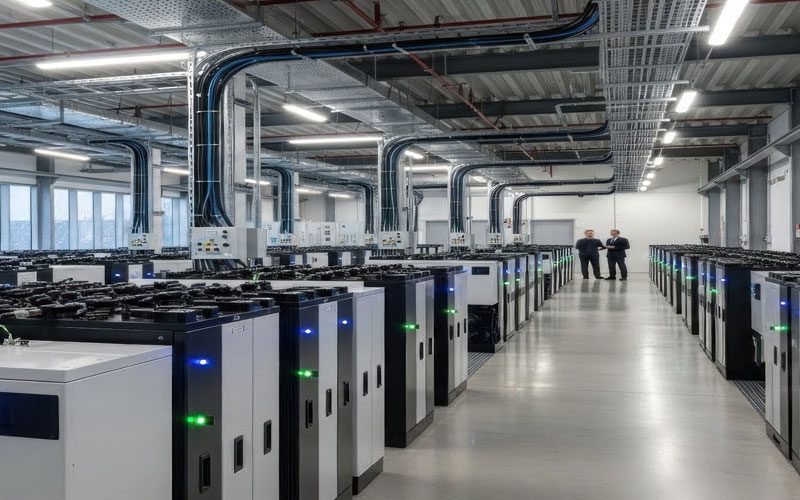
The old model was a building full of servers with some HVAC and a UPS slapped on it. The new model is an industrial site with on-premise power generation, liquid cooling distribution skids the size of shipping containers, water treatment, fuel handling and, in a growing number of proposals, a small modular nuclear reactor. None of them speak BACnet.
Let me repeat that, it’s important: All that equipment runs on programmable logic controllers, and those PLCs speak EtherNet/IP or PROFINET.
That is a problem for every protocol gateway vendor whose product line starts and ends at the BMS.
What Is Showing Up in Data Center Utility Yards
The list of industrial gear that now arrives on a data center loading dock would have looked absurd ten years ago.
Coolant distribution units, or CDUs, sit between the cooling plant and the rack manifolds. They are packaged industrial skids, built by industrial integrators and controlled by Allen-Bradley or Siemens PLCs. They are EtherNet/IP Adapters or PROFINET end-devices out of the box.
Packaged power skids combine medium-voltage switchgear, transformers, UPS systems and protective relays built into a single drop-in unit. They are built by power systems integrators, not BMS integrators. The control layer is a PLC. The communications protocol is EtherNet/IP or Modbus TCP.
On-site power generation arrived faster than anyone expected. Natural gas turbines for prime power. Diesel for backup. The first wave of small modular reactor proposals is in front of the NRC. All of it is industrial process equipment with industrial control systems on top.
Liquid cooling brings leak detection, flow metering, conductivity monitoring and chemistry control. All of those are sensor networks designed for process industries, not buildings.
|
The data center has become an industrial plant, and it needs an industrial control architecture to match. |
Where BMS-Only Communications Protocol Gateway Vendors Fall Short
A protocol gateway vendor that grew up in commercial buildings knows BACnet. They might even know a little Modbus. They rarely speak EtherNet/IP or PROFINET well, because those communications protocols live in factories, not office towers.
This gap is the problem. The CDU (Coolant Distribution Unit) vendor cannot get data into the BMS because the BMS-only protocol gateway does not handle EtherNet/IP. The integrator ends up writing a custom interface, or the data never gets integrated at all.
RTA started in industrial automation before Ethernet and when all we had was Modbus. EtherNet/IP and PROFINET are not bolt-ons. They are the core of the product line. In fact, RTA was the first company to get an EtherNet/IP Adapter certified.
Devices like the 460ETCBS, for example, connect an Allen-Bradley PLC to a BACnet/IP BMS in one box. No PC. No software license. No IT ticket. The same applies to PROFINET, Modbus TCP and the rest of the industrial side.
Why Software Protocol Gateways Are a Worse Answer in the Industrial Layer
Not only are software protocol gateways annoying, in the power yard they are liabilities.
The industrial layer of a data center runs on cycles measured in milliseconds. A Windows or Linux box, patched on Patch Tuesday, occasionally reboots. That is fine for an office. That is not fine for a CDU controller. Industrial deployments are built on hardware that does not reboot itself, does not require an OS license and does not phone home for updates.
The cost picture is also worse. Industrial software protocol gateways carry larger subscription fees, often tiered by tag count, and the tag count in a packaged power skid alone can run into the thousands.
European protocol gateway vendors do better here than software vendors because they at least understand industrial communications protocols. They still carry the long lead times, the high prices and the support model built for European system integrators, not US data center operators on a deadline.
IEC 62443 Is No Longer Optional in the Utility Yard
Hyperscale operators are starting to write IEC 62443 into the build specs. The reason is simple. A data center with on-premise generation and grid interconnects is critical infrastructure, and critical infrastructure attracts the attention of regulators and adversaries who do not care about marketing.
A purpose-built protocol gateway with a defined attack surface, signed firmware and no general-purpose OS underneath fits the standard. A software protocol gateway running on a server in your utility room does not.
The Takeaway for Anyone Designing the Next Data Center Build
Specify the protocol gateway layer first. The communications protocol decisions made in the first thirty days of a project determine whether commissioning takes three weeks or three months. The protocol gateway is not a commodity line item. It is the difference between a data center that works as one system and a data center that has three monitoring stacks fighting each other.
RTA was built for this. Industrial communications protocols. Protocol Gateway Hardware Modules. US stock. US support. One-time purchase. Five-year warranty. No subscriptions. No IT involvement. IEC 62443-aligned firmware.
Contact the RTA Enginerds today to architect the right solution for your data center. Call 1-800-249-1612 now to get started.

