

RTA's Blog
Modbus RTU Over RS-485: An Engineer’s Guide to Industrial Reliability

Aug
Why Modbus RTU Over RS-485 Still Matters Today
Despite the rise of Ethernet-based protocols like Modbus TCP/IP, EtherNet/IP and PROFINET, Modbus RTU over RS-485 remains one of the most deployed communication standards in industrial automation.
Why? For engineers, its value isn’t just in theory. It’s because RS-485 networks are cheap, proven and extremely resilient in noisy environments like refineries, water treatment plants and manufacturing floors.
What is RS-485?
RS-485 stands for Recommended Standard number 485, a physical layer standard published by the Telecommunications Industry Association (TIA) (originally developed by the Electronic Industries Alliance (EIA)). It is an electrical-only standard and does not define any communication protocol, though many common industrial protocol standards, like Modbus RTU, reference RS-485 for their physical layer.
Advantages of Modbus RTU over RS-485
Compared to other common electrical standards such as RS-232 and RS-422, RS-485 offers several key advantages.
High Noise Immunity
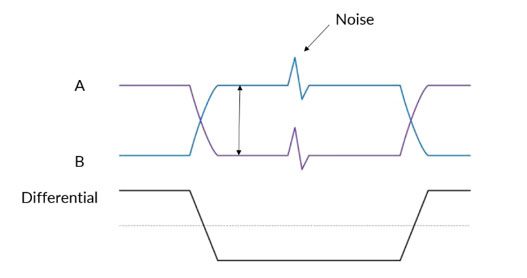
The combination of twisted pair wiring and differential signaling provides high levels of noise immunity. Rather than relying on voltage relative to a ground wire, RS-485 uses the voltage difference between the two wires as the signal. Because any noise interference affects both wires equally, RS-485 is highly resistant to electromagnetic noise (EMI), providing reliability when run next to potential sources of interference like VFDs, motors and similar devices.
Noise immunity can be further enhanced using shielded wires.

Unlike RS-232, which is designed for point-to-point connections, RS-485 supports up to 32 server devices via a daisy chain where devices can be linked to one another over a single pair of wires. This dramatically reduces the cost of wiring/cabling and the need for expensive industrial networking equipment used in Ethernet networks.
Fractional load transceivers allow for up to 247 devices on the bus, provided you maintain proper termination.
Because Modbus RTU uses a strict master/slave architecture where only one device is allowed to speak at a time, it maps perfectly to the half-duplex nature of an RS-485 bus. The Modbus protocol handles traffic control, while the RS-485 hardware handles the physical routing over that single pair of wires.
Distance and Speed
RS-485 supports runs of up to 1,200 m (~4,000 ft) at lower baud rates (e.g., 9600 bps) on cheap twisted pair wire. Comparatively, Ethernet dies at around 100 m (~32 8ft) without expensive switches or repeaters.
While RS-485 can hit 10 Mbps at very short distances (12 m/40 ft), Modbus RTU typically operates at 9600 or 19200 bps. At these lower speeds, the protocol is resilient over long distances and ensures that even slight signal distortion does not corrupt the signal.
Per the original standard, RS-485 supports data rates of 100 kbps at the 1,200 m maximum distance. To support long runs, the Modbus RTU master must be configured with a slightly longer response timeout to allow the signal to travel to the end of the line and back.
In modern applications, the distance is often limited more by the number of devices and cable quality than the baud rate alone.
RS-485 in the Real World: Industries and Use Cases
RS-485 remains one of the most deployed communication standards in industrial automation. Some of the most common use cases include:
- Wastewater Industry: In a wastewater plant, Modbus RTU RS-485 often connects multiple remote pump stations along a single loop. With proper termination, signals remain intact across long cable runs exposed to pumps, motors and lightning strikes.
- Oil and Gas Industry: In oil and gas, remote wellheads often rely on RS-485 Modbus because Ethernet infrastructure isn’t practical.
- SCADA over Serial Radio: Modbus RTU runs well over licensed/unlicensed radios for remote pumping stations.
- VFD and Motor Control: RS-485 is often the factory default for drive communications.
- Retrofit Automation: When upgrading legacy PLCs, Modbus RTU over RS-485 offers a low-cost bridge into modern HMIs or gateways.
Wiring and Troubleshooting Nuances
Designing RS-485 networks isn’t just ‘use twisted pair and terminate at the ends.’ Experienced engineers know the pitfalls:
- Reflections: If termination resistors are missing or misapplied, reflections cause phantom data. Oscilloscopes will reveal ‘ghost’ pulses at each bit transition.
- Biasing resistors: Without biasing, idle lines float and devices may interpret noise as valid data.
- Grounding: In mixed-voltage environments (e.g., connecting drives from different panels), ground potential differences can inject noise into the bus. Isolated transceivers are often a must.
Real Example: A packaging plant once experienced random data drops when a new VFD line was installed. Adding shielded cable and proper biasing resistors restored network stability.
Limitations of Modbus RTU over RS-485: The Engineer’s View
Engineers still choose Modbus RTU over RS-485 due to its noise immunity, affordability and near-universal support from virtually every PLC, drive and HMI vendor. However, there are some drawbacks.
Limitations you must account for:
- Half-duplex: Only one device talks at a time. Improper timing leads to collisions
- Speed: Even at 115.2 kbps, Modbus RTU is slow compared to Ethernet
- Scaling: Beyond ~50 devices, troubleshooting response latency becomes painful
When to Choose RS-485 Modbus Over Ethernet
Choose Modbus RTU over RS-485 when:
- You need long cable runs with high EMI resistance
- Budget doesn’t allow for Ethernet switches/fiber
- Backward compatibility with existing PLCs or instruments is critical
Choose Modbus TCP/IP or Ethernet/IP when:
- You need high throughput and real-time performance
- Network scalability and integration with IT systems is a priority
- You’re deploying a new facility with Ethernet backbone infrastructure
Conclusion
For seasoned engineers, Modbus RTU over RS-485 isn’t just a ‘legacy protocol’—it’s still one of the most practical tools in the automation toolbox. By understanding not only the protocol basics but also the wiring nuances, error handling and real-world challenges, you can design networks that perform reliably for decades.
While Ethernet may dominate greenfield projects, RS-485 remains the standard for brownfield upgrades, remote facilities and EMI-heavy environments where reliability matters more than speed.
Modbus RTU over RS-485 FAQs
RS-485 is an electrical standard for the physical layer. Many application layer protocols, like Modbus RTU, are built on top of the RS-485 standard.
RS-485 supports up to 1200 meters with good data integrity. The ability to span long distances makes it particularly valuable for sprawling industrial facilities.
The RS-485 standard allows 32 devices per segment, extendable with repeaters. Modern fractional-load devices often allow for up to 247 nodes without repeaters.
Yes, Modbus is an open protocol and has no licensing fees.

