

RTA's Blog
What Engineers Get Wrong About IEC 61850
Nov
I’ve spent a lot of years helping people move data around factory floors. It started with RS-485, then grew to Modbus, PROFIBUS, EtherNet/IP, PROFINET. I thought I’d seen every flavor of communications headache there is.
Then the calls started changing.
An engineer from Philly called and said his ControlLogix needs breaker status and some power quality numbers. The electrical contractor told him the relay in the switchgear lineup “does 61850.” He wants to know what that is and which registers to read.
Sorry, Mr. Philly. No registers. That’s the whole point.
The Power Industry Had Our Integration Problem, Only Nastier
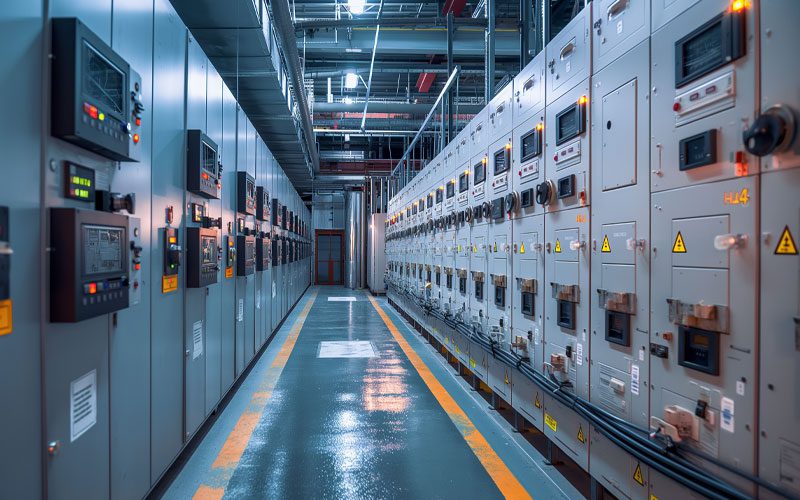
Picture a substation full of protection relays, revenue meters, breaker controllers, bay controllers, tap changer controls, battery monitors and RTUs. Now picture all of that coming from four or five different manufacturers, because no utility on earth buys everything from one vendor.
Sound familiar? It should. We’ve been running that old movie since the days of drive-ins. Different boxes, different protocols and nobody talking to anybody.
But the power industry had a second problem we never had. The signals that actually matter in a substation (e.g., a relay telling a breaker to open right now) weren’t on a network at all. They ran over dedicated copper pairs, one pair per signal. A substation with a few dozen protection schemes held miles of control cable, and somebody had to design every strand, pull it, land it, label it, ring it out and maintain it for the next forty years.
Yikes! That’s not an integration problem. That’s an entire construction budget.
What Engineers Get Wrong about IEC 61850
The IEC Technical Committee 57 folks decided the fix wasn’t another protocol. What they did was to standardize the vocabulary first, thus creating the 61850 standard. That’s where most people’s thinking goes astray. They put IEC 61850 in the same mental bucket as Modbus TCP or EtherNet/IP. It doesn’t fit there.
In the Modbus world, a device hands you a number and a document somewhere explains it. Holding register 40017 contains a value; scale it by ten (and by the way, the high byte comes first). If you lose that document, you’re screwed.
In an IEC 61850 world, the device tells you what it’s giving you. It says, “This is the phase A voltage” and here’s the value. There’s a quality flag saying whether you should believe it. There’s the timestamp saying when it was true. You don’t need a spreadsheet, and you don’t need to call the vendor.
The IEC 61850 Framework
IEC 61850 is really four things stacked together:
- An information model. What the data means. What a circuit breaker is, what a measurement is, what a protection function is.
- Communication services. What you’re allowed to do with that information. Read it, write it, subscribe to it, operate equipment with it.
- Communication mappings. How those services actually get across the wire. There’s more than one, and that’s deliberate.
- A configuration language. System Configuration Language (SCL), an XML format that describes devices and whole systems so engineering tools from different vendors can hand work back and forth.
If you already know OPC UA, you recognize this shape immediately; modeling separate from transport, built-in self-description and an engineering format on the side. IEC 61850 is that same idea, aimed squarely at electrical power, and it arrived first.
Everything Is an IED
If you’re like me, you’ll trip over this acronym constantly. IED means Intelligent Electronic Device, and it’s just the umbrella term for anything smart in an electrical system, such as protective relays, power meters, breakers and bay controllers.Whatever it is, if it participates in IEC 61850, it publishes its functions and data using the standard model. That’s what makes it an IED rather than a box with an Ethernet port.
Why You Should Care About IEC 61850 If You Live on the Factory Floor
The story of IEC 61850 isn’t only a substation story anymore. Your two worlds are colliding.
IEC 61850 was born in substation automation, but it didn’t stay there. It’s now running in distributed energy resources, solar farms, battery storage, hydro plants, wind generation, distribution automation, microgrids, industrial electrical distribution and data center power infrastructure. The IEC woke up to this and started calling it a power utility automation standard. That’s a more honest description of where it ended up.
Meanwhile, your factory floor and your electrical systems are crashing into each other. Your PLC wants breaker status, volts, amps, frequency, power, energy, power quality and alarms. That data lives in equipment that speaks IEC 61850. At the same time, the electrical system may want data that lives in your controllers and meters.
Nobody wants to solve that by turning a PLC programmer into an IEC 61850 expert. That’s a year of somebody’s life and a maintenance liability forever.
And that makes this a bigger deal today than it was twenty years ago. Everybody wants to point AI and analytics at their plant data, but those systems are only as good as the context that arrives with the numbers. Bare values with no meaning attached are exactly what makes those projects stall. Because IEC 61850 ships with the context in the box, understanding it is critical for anyone trying to bridge modern power infrastructure with smart factory systems.
Got a complex electrical integration puzzle or plant floor communication hurdle? Tell our Enginerds what you’ve got, what it needs to reach and which data has to move. We’ll handle the hard part.
Here’s the number to call: 1-800-249-1612, or email the team at solutions@rtautomation.com.

