

RTA's Blog
How a Machine-level Historian Quickly Fixes PLC Issues Without IT Infrastructure or Recurring Cost
Aug
It’s 2:07am. Third shift is running normally. There are no critical alarms and no obvious fault. The machine stops and production is down. Nobody knows why.
With no controls engineer on site and the maintenance team stretched thin, the operator does what they can do. They clear the screen, walk through the startup sequence, re-home what needs to be homed and get the line running again. It stays running the rest of the night.
In the morning, you have downtime costs and zero evidence why:
- Operations recorded “maintenance downtime”.
- There is no clean root cause because the fault cleared during restart.
- The HMI trend rolled over. The right tags were not trending anyway.
- The alarm list shows possible symptoms.
- Everyone has a different theory. Nobody can prove it.
At 9:00am the engineer asks the only (unanswerable) question that matters: “What changed first in the 10 seconds before the outage?”
The problem goes away. Until it comes back two nights later.
Common Workarounds for This Kind of Control Problem (and Why They Fail)
Controls teams usually start with what they can do fast and with what they already have. These fixes can work. They also fail in predictable ways.
| Workaround | Description | Why It’s Attractive | Why It Fails |
|---|---|---|---|
| Add More HMI Trending | Trend a handful of tags and try to “catch it in the act.” | Already available. Implemented in minutes. | Wrong tags in the HMI, incorrect sampling rate and no ability to define an appropriate event trigger. |
| Use PLC Data Logging | Log values to arrays, shift registers or files, then export. | Feels precise. Comfortable using PLC to debug the PLC. | Eats memory/scan time. Debug logic becomes mini project. Logs are flat, hard to query and often without timestamps. |
| The “Tuning Fix” | Adjust PIDs, add deadbands and filter inputs to reduce oscillation and chatter. | Often improves symptoms quickly. | Often masks real cause. Filtering and deadbands add lag, hide intermittent faults and make root-cause proof harder. A different condition now triggers the same process upset. |
| Band-Aid Logic | Add delays, one-shots, retries and extra permissives to prevent nuisance trips. | Stops downtime quickly. | Complexity compounds. Maintenance nightmare for next engineer. Cannot tell what logic is “real control” vs. “scar tissue.” Often creates new failure modes. |
| Use A Manual “Incident Log” And Chase It By Memory | Have operators note the time and observe the incident. Engineers review alarms and try to correlate. | Zero cost. | Inaccurate human timestamps. Incomplete observations. Alarm lists are not time-synced to the control state. Unknown what changed first. |
| Escalate To IT Server-Based Historian | Spin up a new server, new VM and install historian. | Powerful functionality, long retention, enterprise standards. | Slow to approve, heavy to deploy and often overkill for a machine-level problem. Dependent on network, servers and IT ownership, which can be where many “intermittent” problems hide. |
How Does A Machine Level Historian Fix This?
Control upsets are usually sequence and timing problems. The evidence is in the seconds before the upset, across many tags and it must survive network and server issues.
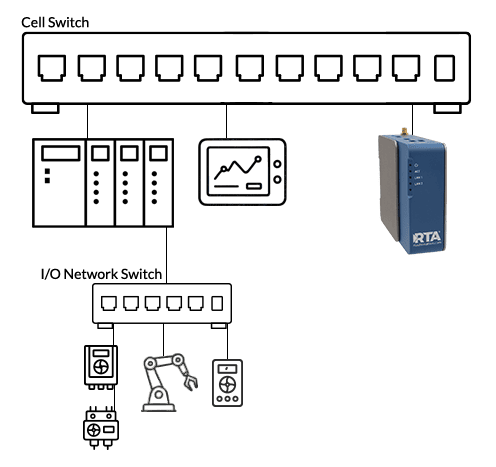
That’s the gap a machine-level historian fills: high-resolution, queryable and time-synced data captured locally at the PLC layer, with retention long enough to catch the “once every two weeks” event, without turning your PLC into a logging project.
The machine-level historian shrinks the search space!
Calculating the ROI of a Machine-Level Historian
Downtime costs are enormous:
- Lost immediate revenue
- Remediation costs for time (overtime?) and materials spent on recovery
- Possible disruption of your supplier’s business
- Lost productivity due to disrupted workflows
- Contract penalties
- Bringing systems back online with partial or damaged data
The return on investment (ROI) of a Machine-Level Historian is enormous. It can easily cut resolution time on control system issues by 50% or more.
If your plant downtime costs are $5,000 to $20,000 per hour, just one incident with 15 minutes faster resolution pays for the device. A dedicated machine-level historian is an industrial appliance that can cost under $2,000 and be installed in less than one hour, delivering immediate ROI.
Is a Machine-Level Historian Right for Your Application?
Choose a machine-level historian if:
- You cannot afford to lose data when servers reboot or the network glitches
- You need fast answers on intermittent machine faults, not a week-long investigation
- You need traceability at the machine, cell, or line, not enterprise-wide
- You do not want to stand up a Windows server or VM just to store trends
- Corporate IT is not available, not involved, or not the system owner
- The spend comes out of maintenance or engineering, not an IT capital project
- You want a one-time purchase, not ongoing licenses or subscriptions
- CSV logs are too flat and painful to search, correlate, and prove cause and effect
- You need event-based capture, pre/post-trigger windows and smarter logging than “every second forever”
Look elsewhere if:
- Your core need is tight MES coupling and deep MES workflows, not machine-level evidence capture
- There already is a standardized historian platform
- You need corporate dashboards, cross-plant benchmarking, and heavy analytics as the primary deliverable
- The requirement is enterprise aggregation across sites and plants
- Centralized cloud reporting is a non-negotiable requirement
- Audit trails depend on accurate timestamps you can trust
RTA’s Machine-Level Historian
The RTA Historian is a hardware-based solution that sits in the OT network and provides a dedicated platform for capturing time-series automation data from Allen-Bradley PLCs and Modbus devices. It is designed to capture high-resolution logs, structure them into historian records and make them available for downstream systems.
Delivering millisecond-accurate proof of exactly what changed, the RTA Historian provides you with the evidence you need to solve the hidden causes of control upsets. Read about how the RTA Historian uncovered a recurring PLC failure for a well-known, international product development facility.
To get your specific questions answered, email solutions@rtautomation.com or call and speak to an Enginerd at 800.249.1612.

