

RTA's Blog
The Sticker Price Illusion: The True Cost of a Protocol Gateway
Aug
I’ve been in the gateway business for more than twenty years and there is one incontrovertible fact: “What is the price of the protocol gateway?” will be one of the first questions I’m asked.
But it’s also the least useful.
Asking the price of a protocol gateway is like having a baby because you found a good deal on a hundred jars of baby food. The baby food isn’t the real cost. There are eighteen years of cost to consider.
On the plant floor, the sticker price of a protocol gateway is a rounding error compared to what it can cost over its lifetime. Three hidden factors dictate the real cost of your protocol gateway: ownership model, integration hours and technical support.
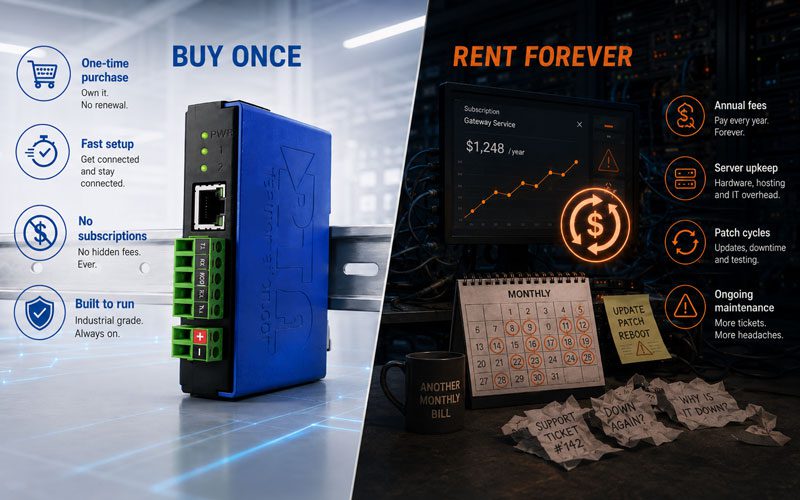
Ownership: Buy Once vs. Rent Forever
Subscription models have become the default for enterprise software, and that trend is creeping into industrial automation, too. Before you make the decision between a software gateway vs. a hardware protocol gateway, ask yourself what you are actually buying.
What Are You Actually Buying With A Software Gateway?
A subscription, yes. But there’s more. You also get:
- A server to manage
- An operating system to keep current
- A security patch landing every Monday morning that somebody must test and apply before it breaks something
The license is only the tip of the iceberg. Maintenance is what drains your engineering budget year after year.
What Are You Actually Buying With A Purpose-Built Gateway?
A device. It gets configured once, mounted and then it runs for years without anyone touching it. There is no server, no patch cycle and no annual renewal email from procurement asking why the line item went up again. Bought once. Done. (Of course, I’m speaking about RTA Gateways)
Hardware-based protocol gateways – whether rack-mounted or standalone – are a one-time purchase. Think about it the way you think about anything else with a recurring cost. Pay once or pay every year for as long as the plant runs. The math is not subtle. A device that asks nothing of you after install is worth more than a subscription that asks something of you every Monday.
Pick once. It is almost always the right answer.
Integration Hours: The Real Cost of Everything
On a datasheet, protocol gateways look like commodities. They look interchangeable. In the field, they are anything but.
The hardware is a one-time number you can read off a quote. The hours your engineer spends fighting a clumsy configuration tool, decoding incomprehensible error messages and waiting on support that never calls back — those are the numbers that wreck a project budget. None of them appear on the quote.
When you compare protocol gateway pricing, the real differentiators are the operational details you can’t see on a quote:
- The configuration experience: Can data mapping be done confidently in 15 minutes or does it require an entire afternoon (or longer) of billable trial and error?
- Actionable diagnostics: Do error messages name the problem or throw a generic error code?
- Support: Who answers the phone – actual engineers or an automated voice menu?
- Firmware discipline: Is the vendor pushing stable, tested firmware or treating your plant like a beta testing ground?
A hard-to-use gateway is not a one-time cost. It is a recurring tax on every project that ever touches it.
As shown below, choosing a $400 gateway actually costs $1,150 more in integrator time. The right protocol gateway saves time, reduces labor cost and gets the job done faster.
| Cost Factor | Software Gateway | Hardware-based Protocol Gateway |
|---|---|---|
| Protocol Gateway Upfront Price | $400 | $1500 |
| Integrator Time Required | 12 hours | 2 hours |
| Integrator Rate | $225/hour | $225/hour |
| Extra Labor Cost | 12 x $225 = $2700 | 2 x $225 = $450 |
| Total True Cost | $400 + $2700 = $3100 | $1500 + $450 = $1950 |
The Hidden Protocol Gateway Spec: Real Live Human Support
Here is a simple truth about plant floor engineering: you can buy the most expensive protocol gateway on the market and the integration will still cost double what the hardware did.
Why? Because, by definition, a gateway sits between two systems that you didn’t design. Vendor docs are frequently thin, out of date or written by someone who has never been on a plant floor. When you hit the wall — and you will — the only thing that gets the project moving again is a knowledgeable human who knows the box and picks up the phone. At RTA, we call those people Enginerds.
What Does Bad Support Look Like?
Bad vendor support is a direct financial drain and comes in many forms:
- Forum-only support that forces your team to query crowdsourced threads, hoping that someone else has had the exact same problem, all while line commissioning halts
- No direct line to engineering. Your technical issues get filtered through automated gatekeepers.
- Ticket response times measured in days that leave system integrators and contractors standing around on active job sites.
Each of those is a red flag, and each one is money.
Evaluating Vendor Support
Plant floor engineers don’t care about vendor marketing or flashy logos. Plant floor engineers want three things, in this order:
- Does it work and do what I want?
- Is it easy to use (everybody will tell you that their product is easy to use)?
- Can I reach a human without clawing through eleven automated menus that all loop back to the main menu?
That is the whole list.
So, try the support before you buy it. Call the line. Time how long it takes to reach somebody who can actually answer the question. Here’s a hint. If the sales process sucks, you can bet the support process will be worse. The reverse isn’t true. Great salespeople don’t mean great support.
What Does a Protocol Gateway Cost? Flip the Question
A protocol gateway is bought on the data sheet, but it is paid for on the plant floor.
Don’t ever ask what a gateway costs. Ask what it costs to live with it. Get one with great support that is easy to integrate, and it will quietly be the lowest total cost you will find. Instead of rearing its ugly head to shrink your engineering budget, it will quietly disappear into the background, doing its job for years.
RTA protocol gateways are simple, drop-in solutions that are designed to specifically eliminate every hidden tax on your engineering budget:
- Always In Stock: No long lead times or supply chain delays holding up your projects
- Same-Day Shipping: Orders placed before 2:00 PM CST ship the very same day so you can get your protocol gateway when you need it
- Buy It Once: Purpose-built, industrial hardware with zero annual subscription fees, zero server maintenance and no surprise patch cycles
- Fast to Deploy: Using a browser-based configuration screen, the gateway can be set up in less time than it takes to make a cup of coffee. Straightforward data mapping saves hours of trial and error.
- Live Enginerd Support: When you call us for help, a live person answers the phone from our Wisconsin-based headquarters. No support tickets or 24-hour wait times.
Better yet, all RTA gateways include a 5-year warranty and 30-day money back guarantee.

